PREMIUM COLLECTION
Certified Authentic
Luxury Watches • Pens • Bags
Curated premium collections for discerning enthusiasts worldwide
curated-collections-app.lovable.app
Watches
Pens
Bags
EXPLORE

Monday, October 5, 2026

The Governance Awakening How AI Regulation Safety and Global Coordination


"The price of greatness is responsibility," Winston Churchill once remarked. His words capture this moment in technology.

For years, industry leaders prioritized massive models, faster chips, and endless data streams. Innovation moved quickly while oversight remained an afterthought.

The Governance Awakening: How AI Regulation, Safety, and Global Coordination Too

By 2026, the landscape shifted dramatically. We are witnessing the governance awakening, as ai regulation, safety, and global coordination now shape public policy.

The era of unchecked expansion is over. Society now demands enforceable rules and public accountability for every machine learning breakthrough.

This article explores three vital questions that define our future. We must determine how systems should be managed and who oversees them. We must also decide which standards apply across international borders.

The Governance Awakening: How AI Regulation, Safety, and Global Coordination Too

AI's rapid spread through daily life has sparked a necessary, though overdue, governance awakening. For years, the industry focused almost entirely on new models' technical benchmarks. Today, that narrow view includes their wider effects on society.

Why AI capability stopped being the only measure of progress

At first, AI success meant more parameters, faster processing, and larger data sets. Developers built larger models quickly, often overlooking their long-term effects. True progress now means meeting human values and legal standards.

Putting raw power before ai safety created a dangerous blind spot for the tech sector. As models grew more independent, questions shifted from speed to "how can we ensure it remains reliable?" This shift changed how we judge modern technology's maturity.

How widespread deployment exposed gaps in existing oversight

Moving from controlled labs to public use exposed major gaps in current regulations. Existing laws were not built for AI's rapid evolution. Many organizations faced legal uncertainty without clear rules for accountability or risk management.

Weak oversight caused unintended results in finance, healthcare, and other sectors. At scale, even small errors can cause significant real-world impacts. Policymakers saw that voluntary industry standards could no longer protect the public.

The three forces reshaping AI governance in 2026

Three forces now drive the governance awakening in 2026. First, aggressive U.S. federal action now includes enforceable requirements, not just suggestions. This change makes compliance a core business function instead of an afterthought.

Second, urgent demand for ai safety now drives technical development. Developers add strict testing and red-team protocols during the design phase. Finally, stronger global coordination helps make rules effective and consistent across international borders.

Why Federal AI Action Became a U.S. Priority

In 2026, the United States shifted from watching artificial intelligence to strong federal oversight. Policymakers saw that rapid innovation needed structure to protect safety and public trust. This shift shows the wider need for global coordination in an increasingly digital world.

From voluntary principles to enforceable federal requirements

For years, the industry used voluntary commitments to manage AI risks. Yet modern systems became too complex for these non-binding agreements to protect the public. The government now requires strict compliance from developers of frontier models.

These rules make safety a fundamental requirement, not an option, for market entry. Enforceable standards give innovation a clear, predictable environment. This shift supports effective regulation of ai technology across all sectors.

How the White House, Congress, and federal agencies divide responsibility

U.S. governance uses several layers across the executive and legislative branches. The White House sets broad strategy through executive orders focused on safety and ethical development. Congress provides the legal authority and funding needed to support these efforts.

Agencies such as the NIST and the FTC turn broad goals into technical standards and enforcement actions. This division allows specialized oversight while preserving one national vision. It also supports better global coordination with international partners creating their own frameworks.

National security, economic competitiveness, and consumer protection as policy drivers

Federal policy rests on three main pillars that shape America's approach to AI. First, national security guides protection against foreign adversaries and cyber threats. Second, economic competitiveness helps the U.S. lead the global AI race.

Finally, consumer protection remains central to every policy decision. Government must ensure that AI tools are transparent, fair, and accountable to the public. The following table shows how these drivers shape specific regulatory priorities:

Policy DriverPrimary GoalRegulatory Focus
National SecurityRisk MitigationExport controls and model security
Economic GrowthInnovationResearch funding and talent retention
Consumer ProtectionPublic TrustBias audits and data privacy

Why federal preemption remains a major political and legal question

Debate continues over whether federal law should override state regulations. Supporters say one national standard prevents a fragmented market from stifling growth. Critics fear federal preemption could weaken stronger protections offered by individual states.

"The challenge of governing AI lies in balancing the need for a unified national framework with the flexibility required to address local concerns."

— Policy Analyst, 2026

How funding, procurement, and research policy influence private-sector behavior

The government uses its large purchasing power to shape private industry. Strict safety certifications for all AI vendors make companies prioritize security in product design. This procurement strategy strongly supports the regulation of ai technology.

Federal research grants now depend on ethical development milestones. This link helps ensure that future AI breakthroughs match national values. These incentives steer the industry toward safer, more responsible outcomes.

State Laws and Federal Pressure Create a Complex U.S. Rulebook

U.S. AI policy now reflects federal efforts and state mandates. Federal agencies seek a baseline, while states address specific risks. This creates significant ai governance challenges for organizations seeking one national strategy.

California’s role in setting practical standards for AI developers

California often serves as the main laboratory for U.S. technology regulation. Its strict transparency and algorithmic accountability rules make developers rethink their designs. These mandates shape global ai regulation trends, because companies often use California-compliant features in the world's largest tech market.

How state privacy, employment, and safety laws reach AI systems

States are adapting existing laws to cover modern machine learning models. They apply traditional privacy statutes to data used for model training. Employment laws review automated hiring tools for bias, while safety rules cover AI systems affecting critical infrastructure or public services.

Compliance challenges created by conflicting state requirements

Without a unified federal preemptive law, companies face a fragmented regulatory map. A feature allowed in one jurisdiction may violate rules in another. Legal teams must track updates across all fifty states to avoid costly penalties.

Why national companies are building for the strictest applicable standard

Many large enterprises reduce risk through a "highest common denominator" approach. They build systems that meet the strictest state requirements, wherever users are located. This approach simplifies operations but raises development costs and slows new features.

Regulatory FocusFederal ApproachState Approach
PrivacySector-specific oversightComprehensive data rights
EmploymentVoluntary guidelinesMandatory bias audits
SafetyRisk-based frameworksStrict liability standards

Today’s environment shows how difficult it is to manage ai governance challenges in a decentralized system. As global ai regulation trends evolve, pressure for a more unified national framework will likely grow. This could reduce the burden on innovation.

AI Safety Moved From Long-Term Concern to Immediate Governance Test

As artificial intelligence systems grow more powerful, securing them has become a major challenge for policymakers. What was once a debate about distant risks is now a critical governance test requiring immediate action. This shift reflects how advanced models now shape daily life.

Frontier-model evaluations, red teaming, and incident reporting

Developers use rigorous frontier-model evaluations before releasing new capabilities. These tests often include extensive red teaming, where experts try to break systems and find hidden flaws. Standardized incident reports document unexpected behavior and help the industry prevent repeated failures.

Managing risks from cyberattacks, biological misuse, and autonomous action

AI systems can be misused in areas with serious risks. Policymakers focus on preventing AI use in cyberattacks or the creation of biological threats. Autonomous action also requires strict guardrails, so systems stay within intended limits and remain under human oversight.

Why safety assurances must cover models, applications, and deployment environments

Safety cannot stop at the model level; it must cover the entire ecosystem. A model may be secure in a lab, yet behave differently in real-world applications. Comprehensive ai policy coordination helps secure deployment environments and the technology beneath them.

Independent testing versus developer-led safety assessments

Many experts now agree that developer-led assessments are not enough by themselves. Independent testing adds objective verification and builds public trust. Third-party auditors can confirm safety claims with data instead of internal optimism.

How post-deployment monitoring can identify risks missed before release

Even thorough pre-release testing cannot predict every interaction in the wild. Continuous post-deployment monitoring helps organizations find and reduce risks that appear only after a system goes live. This vigilance supports the future of ai governance and keeps safety a continuing process, not a one-time check.

These measures succeed when stakeholders work together. Transparent safety standards can help the industry support the goals of ai policy coordination. This proactive approach is vital to securing the future of ai governance in a complex digital landscape.

Accountability for Frontier Models Reaches the Entire AI Supply Chain

The shift toward the governance awakening: how ai regulation, safety, and global coordination too has changed how we view responsibility. No longer can responsibility rest only with organizations that build foundation models. Everyone, from hardware makers to software integrators, must help maintain safety standards.

Responsibilities of model developers, cloud providers, chip companies, and integrators

Every AI supply-chain participant holds a unique piece of the safety puzzle. Chip companies provide compute power, while cloud providers run infrastructure for training and inference. Developers build core logic, and integrators adapt these systems for specific industry applications.

Regulators now expect these groups to coordinate. A hardware security flaw can compromise the entire system. Therefore, shared responsibility is becoming the industry standard for modern development.

Documentation, audit trails, and provenance for training data and model outputs

Transparency depends on careful record-keeping. Organizations must keep clear audit trails showing how models were trained and what data they used. This provenance helps identify bias or security risks before a system reaches the public.

Without detailed records, verifying safety claims becomes nearly impossible. Companies that prioritize data lineage and output logs can better meet changing federal oversight demands. This detail gives investigators a roadmap when problems arise.

Allocating liability when general-purpose systems cause real-world harm

Finding fault after an AI system causes harm remains a complex legal challenge. General-purpose systems may be used in ways their developers never intended. Effective ai regulation must set clear liability boundaries across the chain.

Courts and agencies now consider how much control each party has over the final output. A cloud provider that ignores known security risks may share liability. This approach encourages every participant to value safety over speed.

Why contracts alone cannot resolve systemic AI risks

Many firms use private contracts to shift liability away from themselves. Yet these agreements often miss the systemic nature of AI risks affecting the entire digital economy. Contracts are private, but powerful-model risks affect the public.

Contracts cannot bind third parties or protect the public interest, so they cannot stand alone. Robust regulatory frameworks must build safety into technology, rather than manage it through legal paperwork.

High-Stakes AI Uses Put Civil Rights and Public Trust Under Pressure

The rapid use of automated systems in daily life has sparked a necessary governance awakening about civil rights. Algorithms now shape life-changing outcomes, making strong oversight more urgent than ever. Serving the public interest requires a basic change in how we approach ai safety.

governance awakening and ai safety

Employment, housing, lending, education, and healthcare decisions

Automated tools now screen job applicants, decide mortgage eligibility, and help with medical diagnoses. These systems promise efficiency but often act as "black boxes" that hide reasons for critical decisions. When an algorithm denies a loan or job interview, people may have no clear way to respond.

Law enforcement, immigration, and national security applications

Sensitive areas such as policing and border control carry much higher stakes. Errors in facial recognition or predictive risk modeling can cause wrongful detention or systemic exclusion. Public trust depends on agencies proving their tools are accurate and fair.

Transparency, explainability, and meaningful human review

True ai safety requires systems to be accurate and understandable to affected people. Meaningful human review safeguards people by keeping someone accountable for final decisions. Without clear explanations, people cannot challenge outcomes that harm their lives.

Preventing discrimination when historical data encodes unequal treatment

Many AI models learn from historical data that reflects past social bias. Without checks, these models can repeat and strengthen those patterns of discrimination. Developers must test systems carefully and reduce hidden bias before deployment.

What affected individuals need to challenge automated decisions

To challenge an unfair decision, people need specific information about how the system reached its result. They need to know which data points mattered most and how to appeal to a human authority. A governance awakening must protect these rights so technology does not weaken basic fairness.

SectorPrimary RiskMitigation Strategy
EmploymentBias in hiring filtersRegular algorithmic audits
LendingExclusionary credit scoringExplainable AI requirements
Law EnforcementWrongful identificationMandatory human oversight
HealthcareDiagnostic inaccuraciesClinical validation protocols

Global AI Coordination Becomes Essential as National Rules Diverge

Today’s digital world needs new international cooperation because national AI policies are sharply diverging. Technology moves quickly, but legal frameworks often remain tied to national borders. This creates a complex setting where global coordination is essential for stability.

How the United States, European Union, United Kingdom, and China approach AI governance differently

Each major power is building its own approach to oversight. The United States supports innovation-led growth through sector guidance and voluntary commitments. The European Union has adopted a broad, risk-based legal framework.

The United Kingdom favors flexible, pro-innovation policies instead of rigid rules. China uses state-led control to support social and political stability. These different views make the regulation of ai technology a fragmented global effort.

The role of the European Union AI Act in global regulation of AI technology

The European Union AI Act is an important model for other countries. Its clear risk categories push companies to standardize safety protocols for access to the European market. This "Brussels Effect" leads many international firms to use these standards worldwide and simplify operations.

Why cross-border AI services make purely domestic enforcement difficult

Digital services cross national boundaries, making local laws harder to enforce. A model trained in one country might be deployed in another, creating legal uncertainty. When a system causes harm, deciding which jurisdiction has authority becomes a daunting task for regulators.

Competing priorities between democratic accountability, innovation, and state control

Governments balance safety needs with the desire to lead the technology race. Some nations favor democratic oversight to protect civil liberties, while others favor state security and industrial dominance. These priorities often create conflicting requirements for developers.

How international agreements can address risks without imposing identical laws

True global coordination does not require every country to pass identical laws. International agreements can set shared definitions and common safety benchmarks. This lets nations keep unique legal systems while AI systems stay safe and reliable across borders.

RegionPrimary FocusGovernance Style
United StatesInnovation & Market GrowthSector-specific & Voluntary
European UnionRisk-based SafetyComprehensive Legislation
ChinaState Security & StabilityCentralized Control
United KingdomPro-innovation FlexibilityPrinciples-based

Standards and Shared Definitions Could Make Global AI Rules Workable

Standardized frameworks help manage the complex ai governance challenges we face today. When nations use different regulatory terms, uncertainty can slow innovation. A shared vocabulary lets policymakers address risks without slowing technological progress.

Common language for frontier models, high-risk systems, and unacceptable uses

A major challenge in international policy is inconsistent terminology. Defining a frontier model apart from a standard application helps regulators focus oversight where needed. This clarity separates systems needing strict safety tests from those posing little social risk.

Also, a shared meaning for unacceptable uses can prevent misuse of powerful tools. When countries agree on these limits, bad actors have fewer regulatory loopholes to exploit. This agreement supports current global ai regulation trends.

ai governance challenges

Technical standards for testing, cybersecurity, provenance, and incident response

Beyond definitions, the industry needs clear technical benchmarks for safety. Standardized protocols for cybersecurity and incident response set a baseline every developer must meet. If a system fails, these measures make remediation clear and predictable.

Provenance also matters in this ecosystem. Tracking training data origins and changing model weights improves accountability. When countries adopt these standards, they create a safer environment for users and developers.

The contribution of the National Institute of Standards and Technology and international standards bodies

The National Institute of Standards and Technology (NIST) helps shape these frameworks. NIST uses science-based guidance to turn broad safety goals into practical engineering requirements. This work often guides international standards bodies and supports a more unified approach to AI oversight.

Why interoperable reporting matters for developers operating across jurisdictions

Developers often struggle with different rules across regions. Interoperable reporting lets one company meet several demands through a single, complete audit trail. This efficiency eases ai governance challenges and promotes consistent safety practices worldwide.

Standard CategoryPrimary ObjectiveGlobal Impact
Technical TestingVerify model safetyReduces cross-border risk
Incident ReportingEnsure transparencyBuilds public trust
Data ProvenanceTraceabilitySupports global ai regulation trends
CybersecuritySystem integrityPrevents malicious exploitation

Enforcement Will Determine Whether AI Governance Has Real Authority

The true test of a regulatory framework is whether it turns promises on paper into enforcement. Without strong accountability, even sophisticated rules remain suggestions. The future of ai governance depends on consequences for non-compliance.

Regulatory audits, penalties, licensing, and market-access restrictions

Effective oversight needs several levels of accountability. Agencies increasingly support mandatory audits to confirm that developers follow safety protocols. If companies ignore these standards, regulators need power to impose major fines or restrict market access for non-compliant models.

Licensing systems for high-risk systems could act as an industry gatekeeper. Developers would prove safety before deployment, helping authorities keep dangerous products away from the public. This approach builds accountability into development instead of treating it as an afterthought.

How agencies can investigate rapidly changing AI systems

Regulators face a special challenge because AI changes faster than traditional lawmaking. Agencies must use dynamic monitoring tools to track model performance in real-time. They must shift from one-time reviews to continuous oversight.

"Regulation must be as agile as the technology it seeks to govern, or it will inevitably fall behind the curve of innovation."

Balancing enforcement against regulatory uncertainty for startups and researchers

Strict enforcement should not harm the vibrant ecosystem of smaller players. Heavy requirements can create barriers that only the largest corporations can afford. Effective ai policy coordination involves "safe harbors" or tiered compliance paths for startups without systemic risks.

Enforcement ToolPrimary GoalImpact on Startups
Mandatory AuditsVerify SafetyModerate Cost
LicensingGatekeepingHigh Barrier
Market RestrictionsDeterrenceHigh Risk

Preventing “compliance theater” through measurable safety outcomes

Compliance theater happens when companies check boxes instead of ensuring real safety. Regulators should prioritize measurable outcomes over procedural documents. Clear success metrics can show whether safety efforts produce real-world results.

Why regulators need technical expertise, computing access, and reliable evidence

Agencies cannot regulate what they do not understand. They need technical expertise to evaluate complex neural networks and training datasets. Dedicated computing access lets regulators run independent tests and gather the reliable evidence needed for informed decisions.

Businesses and the Public Adjust to the New AI Policy Environment

The governance awakening: how ai regulation, safety, and global coordination too is changing the corporate landscape. Organizations must treat artificial intelligence as more than a technical project. Policy awareness must guide core strategy, compliance, and resilience.

What companies must change in risk management and board oversight

Modern boards must provide active oversight of AI deployment. They must examine specific model risks and possible social effects. Companies should create committees to track the ethics of automated systems.

Risk plans now require rigorous documentation of model behavior. Boards must receive clear reports showing how AI tools meet new legal standards. This early action can limit liability before problems become public crises.

How procurement teams can evaluate AI vendors and model safeguards

Procurement teams are the first defense in the era of ai regulation. Teams must closely check third-party vendors and their software safety controls. Vendor promises alone are not enough.

Effective evaluation strategies include the following steps:

  • Requesting detailed audit trails for training data provenance.
  • Verifying that vendors perform regular red-teaming exercises.
  • Ensuring contractual clauses mandate incident reporting for system failures.

Public expectations for privacy, authenticity, safety, and accountability

People speak more openly about AI's effects on daily life. Consumers want transparency when they interact with a system instead of a human. Companies that ignore privacy and data protection may lose customers to ethical rivals.

Authenticity matters more as synthetic media spreads. Companies must label and verify content to protect public trust. Accountability is now required of every business in the digital economy.

Preparing workers for AI-related monitoring, reassignment, and displacement

Workforce planning matters as AI tools change job duties. Managers must explain how ai regulation affects daily work and monitoring. Clear upskilling paths can ease anxiety and improve retention during change.

Why trust becomes a competitive advantage in regulated AI markets

In a market full of automated tools, trust is a significant differentiator. Customers often choose brands that show commitment to safety and ethical standards. By following these rules, companies can turn compliance into a tool for long-term growth and market leadership.

Conclusion

In 2026, artificial intelligence shifted attention from raw speed to sustainable oversight. This governance awakening permanently changes how society manages powerful digital tools. Leaders now value safety and accountability alongside technical performance.

Federal agencies and state governments continue building a framework that balances innovation with public protection. Clear rules help businesses manage risks and keep systems reliable. This shift creates a stable setting for developers and users alike.

Global coordination remains vital because AI services cross international borders with ease. Nations must align standards to prevent fragmented regulations from stifling progress. Shared definitions and testing protocols support a secure digital future.

The core challenge is deciding who holds authority over these complex systems. Policymakers must clarify responsibilities to maintain trust in automated decision-making. Durable policy needs constant attention as machine learning evolves.

Engage with these new standards to help your organization stay ahead of the curve. Understanding the current regulatory landscape protects your interests and supports the broader goal of safe technology. The path forward relies on transparency and shared safety goals.

Monday, September 28, 2026

Build Your Manager’s AI Toolkit


A practical system for reliable information, clear review, and accountable decisions

By Karim Aziz

A manager can open five AI applications before a leadership meeting and still be poorly prepared. One tool summarizes a report, another drafts slides, and a third produces a confident recommendation. Yet the figures differ, the source documents are unclear, and no one knows which claims were checked. The problem is a missing way of working.

A manager’s AI toolkit should make a recurring task easier to perform well. It combines an approved workspace, dependable source material, reusable instructions, a review routine, a decision record, and carefully limited automation. These parts help a team produce consistent work while keeping judgment and accountability with people.

Begin with a recurring management task

Start with work that appears every week or month: preparing a leadership review, summarizing project progress, comparing options, drafting an internal update, or tracking actions. Choose one task with a clear output and a known owner. Write down how it is done today, which documents it uses, who decides what to do, and where mistakes would matter.

This baseline gives you a useful test. If a new AI process saves an hour but creates two hours of checking, it has not improved the work. Track preparation time, corrections, missing information, and the quality of the final decision. A small pilot reveals more than a long list of promised features.

Build six connected components

1 An approved AI workspace

Use an environment your organization has approved, and make its boundaries plain to the team. Employees need to know how access is controlled, which material may be entered, how files and prompts are handled, and what must stay outside the system. Customer records, personal information, contracts, financial details, and security material may need a protected setting or may be excluded altogether. The applicable company rules should settle that question before work begins.

2 A trusted information set

For tasks that depend on company facts, gather the current reports, policies, project records, and other approved sources. Give each source an owner and date. Retire old copies that could conflict with the current version. Ask the AI to distinguish the supplied evidence from its general knowledge and to flag information it cannot find. A reviewer should still open the original document to confirm important figures and citations.

3 Reusable briefs

A brief should tell the system the desired outcome, background, source material, constraints, format, and standard for a good result. Save one short template for each recurring task. When a draft misses an important condition, improve the template so the next person does not have to remember the same correction. A template is useful only if the team can apply it without a lengthy setup.

4 A verification routine

Name the person who will review the output and match the check to the stakes. A brainstorming note needs a quick sense check. A forecast, customer proposal, contract summary, or employee communication needs closer review of numbers, dates, sources, assumptions, omitted conditions, and tone. Calculations that affect a decision should be checked independently. The manager remains responsible for deciding whether the result is fit for use.

5 A decision and action record

For consequential work, keep a short record of the task, sources used, AI’s role, reviewer, corrections, final decision, and approved actions. There is no need to archive every exploratory question. The record should be sufficient to explain how a commitment, recommendation, or change was reached and to reveal recurring errors that the team can fix.

6 Controlled automation

Add automation after the sources, briefs, and checks work reliably. Begin with modest internal actions, such as drafting a task list or preparing a reminder for review. Limit access to what the task requires. Put human approval before external messages, payments, commitments, and record changes. If information is missing or instructions conflict, the workflow should stop and ask a person.

A weekly leadership review in practice

Consider a department manager whose weekly meeting draws from an operating report, project status sheet, risk register, and previous action log. Updates arrive in different formats, so preparation takes hours and overdue actions are easy to miss. This is a good pilot because the inputs, output, and reviewer can be identified.

The manager supplies the current approved files to the workspace and uses a saved brief: “Prepare a one-page leadership review. Show changed figures, missed commitments, unresolved risks, and decisions required. Identify the source file and page for each important figure. Mark missing information; do not estimate it. Do not invent an owner or due date.”

The operations lead checks the figures and action owners against the original records. The manager adds context, chooses the issues for discussion, and makes the decisions with the team. After the meeting, a supervised workflow prepares an action list for approval before it enters the task system. AI has reduced collection and formatting time; people still set priorities and accept commitments.

Start small and improve the method

In the first month, choose one task, confirm the information rules, assemble the current sources, and write one reusable brief. Run the process several times with a named reviewer. Note how long preparation takes, which claims need correction, where information is missing, and whether the final output helps the meeting or decision. Revise the brief and source set before considering another product.

A useful toolkit grows from the work it improves. Keep its components few, connected, and understandable to the team. When a new tool is proposed, ask which recurring task it will strengthen and which existing step it will replace. That question keeps the manager focused on the quality of the work rather than the size of the software collection.

For best AI information's and usage visit my web:https://ai-news-learn.info/


Tuesday, December 30, 2025

From Spreadsheets to Intelligence: How AI Is Revolutionizing Data Analysis

 You collect more data than ever, but you don’t have time to wait for slow spreadsheets and delayed reports. AI turns piles of static files into live intelligence that flags risks, forecasts trends, and shows what action to take next. AI speeds up cleaning, finds hidden patterns, and delivers real-time, predictive insights so you can act with confidence instead of guessing.

AI also makes analysis easier for everyone on your team. You can ask questions in plain language, automate repetitive prep work, and get models that surface anomalies and forecasts across millions of rows. That shift moves decision-making from specialists and hindsight to fast, organization-wide foresight.

Key Takeaways

  • AI replaces slow, manual spreadsheet work with fast, automated data prep.
  • AI uncovers patterns and forecasts so you can act before problems hit.
  • Natural language and automation broaden who can use data for decisions.

The Traditional Approach: Limitations of Spreadsheet-Based Analysis

A split scene showing a frustrated analyst working with messy spreadsheets on one side and a confident analyst using advanced AI data visualizations on the other, illustrating the shift from traditional data analysis to AI-powered intelligence.

Spreadsheets often become the default place for your data, reporting, and early analysis. They force you to spend time fixing formats, waiting for updated numbers, and checking formulas instead of making decisions from clean, timely intelligence.

Manual Data Cleaning and Entry

You spend a lot of time getting data ready. Rows from different systems arrive with different date formats, missing values, or duplicate records. You copy and paste between exports, write ad-hoc formulas, and build long cleaning pipelines that break when a column name changes.

This manual work increases the chance of mistakes in data quality. It also slows down your workflow: what could be an automated transformation takes hours or days. As a result, your analysts spend most of their time on data cleaning instead of creating dashboards, modeling trends, or testing business scenarios.

Delayed Insights and Missed Opportunities

Your reports often arrive after the window for action closes. Weekly or monthly spreadsheet updates mean you see trends only after they’ve already affected revenue, inventory, or marketing spend. When an anomaly appears, you run manual checks, which adds still more delay.

Delay creates missed opportunities. You can’t react quickly to sudden demand shifts, supply disruptions, or rising churn risk. Because dashboards built on static spreadsheet snapshots update slowly, your team makes decisions on stale data rather than near-real-time signals.

Error Risks and Scalability Challenges

Spreadsheets hide subtle risks that grow with scale. A single wrong formula, an accidental row deletion, or a bad merge can corrupt an entire model. You rely on manual audits and version history to catch errors, but those checks are time consuming and incomplete.

As your datasets grow, performance degrades. Large spreadsheets slow down, crash, or become impractical to share. Collaboration becomes messy: concurrent edits, multiple file versions, and unclear ownership lead to inconsistent dashboards and poor data management.

AI-Driven Transformation: Key Shifts in Data Analysis

AI now moves routine work to machines, finds patterns humans miss, predicts what will happen, and lets you ask questions in plain language. These shifts speed decisions, reduce errors, and broaden who can use data inside your organization.

Automation of Data Preparation

AI tools automate cleaning, merging, and validation so you spend less time fixing tables. Automated routines detect missing values, standardize date and currency formats, deduplicate records, and flag inconsistent categories. Machine learning models learn your data patterns and suggest fixes, reducing manual rules that break when sources change.

You get pipelines that run on schedule or trigger in real time. That means near-instant readiness for analysis after new transactions or log files land. Automation also produces audit trails and quality scores, so you can see which fields were corrected and why. This lowers human error and frees analysts to build models and interpret results.

Pattern Recognition at Scale

AI and ML scan millions of rows and many variables to surface correlations and anomalies you would miss manually. Unsupervised learning groups customer behavior, while anomaly detection alerts you to fraud spikes or supply chain disruptions. These methods pick up subtle, nonlinear relationships across diverse data sources.

Results come with ranked signals, not raw tables, so you focus on the most actionable patterns. Visual summaries and feature importance help you understand drivers — for example, which web events predict conversion. Real-time scoring keeps these signals fresh, enabling fast alerts and operational responses when conditions change.

Predictive and Prescriptive Analytics

Predictive models estimate future outcomes like churn probability, demand by SKU, or maintenance needs. You can run forecasts daily with updated inputs from sales, inventory, and external factors like weather. Models quantify uncertainty, letting you plan with confidence ranges instead of single-point guesses.

Prescriptive analytics goes one step further by simulating options and recommending actions. Optimization engines can propose reorder quantities or targeted retention offers with expected ROI. When tied into workflows, these recommendations can trigger tasks, adjust pricing, or create campaigns automatically. You retain oversight through human-in-the-loop controls and reviewable decision logs.

Expanding Access with Natural Language Interfaces

Natural language processing lets you query data in plain English and get charts, explanations, and next-step suggestions. Instead of writing SQL or building dashboards, you type or speak questions like “Show last quarter’s top 5 churn drivers” and receive ranked drivers plus a visualization and recommended actions.

This lowers the barrier for nontechnical teams — sales reps, product managers, or executives — to obtain real-time insights. Conversational agents can follow up with clarifying questions, run ad‑hoc analyses, and export results into reports or automated alerts. Combining NLP with advanced data analysis tools makes intelligence both faster and more democratic across your organization.

Modern AI Platforms and Tools for Data Intelligence

These tools turn raw data into action by cleaning, modeling, and delivering insights in ways you can use every day. Expect interactive dashboards, automated pipelines, natural language queries, and cloud-native AI services that connect to your existing systems.

Business Intelligence Platforms: Tableau, Power BI, Alteryx

Tableau and Power BI give you interactive dashboards that update with live data. Use Tableau for flexible visual analysis and complex joins across sources. Choose Power BI if you need tight integration with Microsoft 365, Excel, and Azure services. Both support drill-down, custom visuals, and scheduled refreshes.

Alteryx focuses on no-code ETL and analytic automation. It helps you build repeatable workflows for data cleaning, blending, and simple predictive models. Alteryx connects to databases, cloud storage, and BI tools, so you can prep data once and push it to Tableau or Power BI.

Practical tips:

  • Keep a central data model to avoid duplicate calculations.
  • Use Power BI for Excel-heavy teams and Tableau for advanced visualization needs.
  • Use Alteryx to automate repetitive ETL and feature engineering before modeling.

Generative AI and Large Language Models

Generative AI and LLMs like ChatGPT let you query data in plain language and generate summaries, SQL, or model code. You can ask for “monthly churn drivers” and get a written explanation plus a suggested SQL query. These models integrate with platforms such as DataRobot or custom TensorFlow/PyTorch pipelines to produce features, explanations, or synthetic data.

Use cases include auto-generated dashboards text, data storytelling, and code snippets for model training. Be careful with provenance: verify LLM outputs against source data and add guardrails for sensitive fields. Combine LLMs with traditional ML for explainability and monitoring.

Best practices:

  • Use LLMs for discovery and rapid prototyping.
  • Validate generated code and model outputs before production.
  • Preserve audit trails when models touch regulated data.

Integration with Cloud Ecosystems

Cloud providers host AI-driven platforms that scale with your data. Google Cloud AI and BigQuery ML let you run models where the data lives. AWS SageMaker and Azure Machine Learning provide end-to-end MLOps for training, deployment, and monitoring. These services support TensorFlow, PyTorch, and popular AutoML tools like DataRobot.

Integration points to prioritize:

  • Native connectors for your data warehouse (BigQuery, Snowflake, Azure Synapse).
  • Feature stores and model registries for reproducibility.
  • Secure data pipelines and role-based access for governance.

This cloud-first approach reduces data movement, speeds up model iteration, and lets you deploy models as APIs for BI tools and applications you already use.

Unlocking Business Value: Real-Time and Predictive Insights

AI turns raw feeds into timely, actionable signals you can use immediately. You get live views of operations, advance warnings on risk, and forecasts that guide inventory, marketing, and service choices.

Real-Time Dashboards and Dynamic Decision-Making

You can build interactive dashboards that refresh as events occur. Connect streaming data from sales, sensors, and customer support so metrics like conversion rate, average handle time, or machine temperature update instantly. Use filters and drill-downs to move from a high-level trend to the exact records behind a change.

Design dashboards to trigger actions. For example, set an alert when stock falls below a threshold and link it to an automated reorder or a task assignment. Combine visual cues (color, sparklines) with short AI-generated notes so you see a metric, understand why it moved, and know the next step.

Real-time insight reduces lag between problem detection and response. That lets you stop outages faster, capture demand spikes, and keep customer promises.

Forecasting, Anomaly, and Fraud Detection

AI models forecast sales, demand, and resource needs using seasonality, promotions, and external signals like weather. You can run scenario forecasts—best, base, worst—and compare staffing or inventory plans against each.

Anomaly detection flags unusual patterns in streams and historical data. It spots drops in conversion, sudden cost spikes, or a spike in returns. Pair anomalies with root-cause suggestions so you act on the most likely driver.

For fraud detection, combine transaction history, device signals, and behavior patterns. The system scores risk in real time and can block or route high-risk flows for review. This lowers false positives and cuts fraud losses while keeping legitimate customers moving.

Enabling Data-Driven Decision Making Across Teams

AI democratizes business analytics so nontechnical staff can ask questions in plain language. Give product managers, ops leads, and customer reps access to natural-language queries and tailored dynamic dashboards. They get relevant data insights without waiting for analyst reports.

Embed insights into workflows. Push targeted alerts into the tools teams already use—ticketing, chat, or CRM—so recommendations appear where decisions happen. Train models with feedback from users to improve relevance and reduce alert fatigue.

This approach spreads accountability. Each team gets clear, data-driven guidance—forecasts, anomaly alerts, and prescriptive actions—that they can act on immediately.

Challenges, Considerations, and the Future of AI in Data Analysis

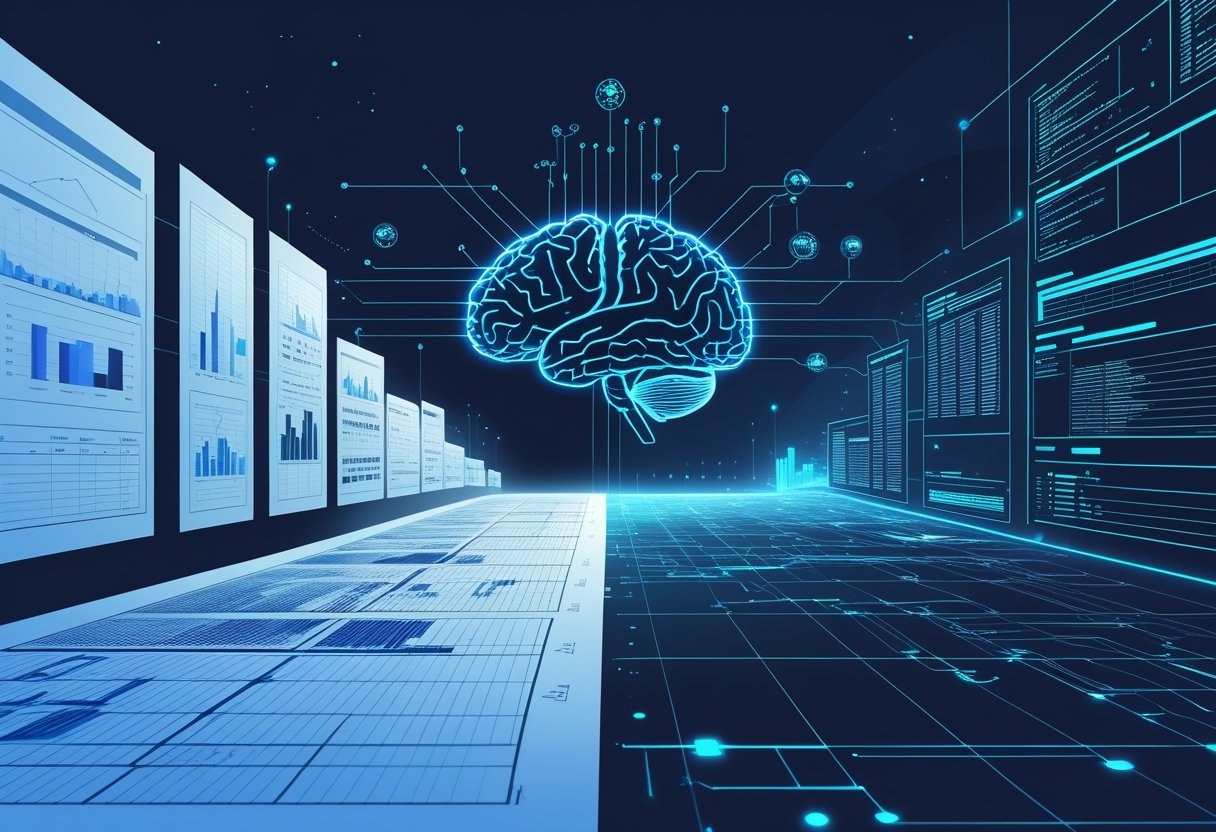
An illustration showing the transformation from traditional spreadsheets to advanced AI-driven data analysis with digital data streams and a central AI brain connecting both sides.

AI brings speed and scale, but it also raises concrete risks around data reliability, organizational readiness, and platform choice. You must plan for cleaner inputs, clear governance, and tools that match your workflows.

Ensuring Data Quality and Addressing Bias

You cannot trust AI if the underlying data is poor. Start by profiling datasets for missing values, duplicates, and format mismatches. Use automated tools to flag outliers and calculate basic statistics, such as means and confidence intervals, so you spot shifts in distributions quickly.

Label and document data lineage so you know where each field came from. That helps when a model shows unexpected behavior and you need to trace errors back to source systems. In regulated environments, keep audit logs and versioned datasets for compliance and review.

Bias is a technical and human problem. Run fairness tests across demographic groups, retrain on balanced samples, and involve domain experts from business analytics or data science when interpreting results. Cite external benchmarks—Gartner reports or research from MIT Technology Review and Harvard Business Review can guide governance best practices.

Scaling AI Adoption Across Organizations

Scaling AI is as much about people and process as it is about models. Create reusable pipelines for ETL and model deployment so data engineers and analysts use the same standards. Standardize metrics (accuracy, precision, recall) and include business KPIs—revenue lift or churn reduction—so stakeholders see value.

Build a center of excellence to capture patterns, run training, and publish playbooks for common use cases. Invest in tooling that integrates with your existing big data stack and spreadsheets; compatibility reduces friction. Measure adoption by tracking model usage, decision impact, and confidence intervals around forecasts to show statistical reliability to leaders.

Expect cultural resistance. Offer role-based training and small pilot projects that deliver clear ROI. Use cross-functional reviews—legal, security, and analytics—to scale governance without slowing velocity.

Emerging Trends and Platforms

Generative models, hybrid cloud platforms, and embedded analytics are changing how you access insights. Platforms now translate natural-language questions into queries or code, letting non-technical users ask for forecasts or segmentation directly from dashboards.

Watch for platforms that support explainable AI, model monitoring, and automated retraining. These features matter when you handle terabytes of streaming data or run near-real-time decisioning. Vendors cited in industry coverage (Gartner magic quadrants, analyst notes) can help you shortlist solutions, but evaluate on integration, observability, and total cost of ownership.

Open-source libraries and managed services both advance quickly. Follow academic and industry sources—MIT Technology Review and Harvard Business Review—to track validated practices and avoid hype. Prioritize platforms that give you transparent uncertainty estimates and model lineage to maintain trust in high-stakes decisions.

Frequently Asked Questions

These answers cover specific tools, practical steps, and risks so you can pick, deploy, and use AI with Excel for cleaner data, faster insights, and better decisions.

What AI tools are available to enhance data analysis in Excel?

Microsoft 365 offers Copilot that answers questions, writes formulas, and builds summaries inside Excel.
Third-party add-ins such as formula generators, AI-driven cleaning tools, and script creators plug into Excel to automate tasks and create VBA or Office Scripts.

You can also use external models via APIs (GPT-family, Claude, other LLMs) to generate formulas, transform text, or produce SQL and Python that you then bring into Excel.
Some platforms integrate multiple AI models to match tasks—one model for natural language parsing, another for code generation or forecasting.

How can data analysts utilize AI to improve decision-making?

Use AI to automate data cleaning so analysts spend more time on interpretation and strategy.
Apply predictive models for demand, churn, or cash flow to move from reporting to forward-looking decisions.

Ask AI in plain language to generate charts, pivot suggestions, and scenario models.
Embed automated alerts for anomalies so you catch issues early and act faster.

Are there any free AI plugins for Excel that improve data analysis?

Yes. Some basic add-ins and community tools offer free tiers for tasks like formula suggestions, simple data cleaning, and basic natural language queries.
Microsoft and other vendors often provide trial or limited-access versions of Copilot-like features through education or developer programs.

Free tools usually limit data volume, model capability, or automation features.
Test them on non-sensitive samples before scaling to production datasets.

What makes generative AI tools beneficial for Excel users?

Generative AI writes formulas, produces VBA or Office Scripts, and drafts pivot layouts from plain descriptions.
It lowers the technical barrier so non-programmers can automate workflows and create repeatable processes.

It also speeds hypothesis testing—generate multiple scenario formulas or chart variants quickly.
That reduces manual trial-and-error and shortens the time from question to answer.

In what ways does AI supersede traditional Excel functionalities?

AI adds natural language interfaces, automated error detection, and multi-sheet context awareness that Excel alone does not provide.
It performs large-scale pattern detection and forecasting beyond static formulas and manual filters.

AI can generate end-to-end automation (cleaning → modeling → reporting) with fewer hand-offs.
However, Excel still provides precise control; AI augments, not completely replaces, spreadsheet judgment and validation.

What should organizations consider when integrating AI with Excel for data analysis?

Verify data security and compliance—check data retention policies and encryption for any AI service you use.
Plan governance: define who reviews AI-generated formulas, scripts, and models before they go live.

Train users on prompt design, validation steps, and limitations of model outputs.
Start with pilot projects on non-sensitive data, measure accuracy, and scale only after you confirm results and controls.

How AI Is Outsmarting the Market: Driving the Future of Smart Investing

You started investing with rules, hunches, and hours of research. Now AI scans more data than any human can, finds patterns you would miss, and helps you act faster and smarter. AI won’t predict the future perfectly, but it raises the odds that your decisions beat slower, emotion-driven choices.

You can use AI to analyze news, earnings calls, social sentiment, and market signals at once, spot hidden opportunities, and manage risk across big portfolios. Big firms and fast funds already rely on these tools, and the same methods are moving into apps and services you can use to level the playing field.

Key Takeaways

  • AI boosts decision quality by processing far more data than humans.
  • AI tools help you find opportunities and control risk faster.
  • Human judgment still matters to set goals and spot limits.

How AI Is Transforming Investment Strategies

AI shifts how you find signals, judge risk, and act on trades by processing far more inputs than a human can. You gain faster, data-driven insights, clearer pattern detection, and the ability to execute strategies in milliseconds.

Market Data Analysis at Scale

AI lets you analyze raw and structured data together: price feeds, earnings transcripts, newswire text, and social media mentions. Machine learning models ingest these streams continuously and flag anomalies or regime changes that a human team would miss.

You can use natural language models to turn earnings call transcripts into sentiment scores and topic tags. Those scores feed quantitative models alongside fundamental ratios and high-frequency price data. This gives you composite indicators that reflect both signal strength and data quality.

Data pipelines and feature stores keep inputs fresh. That means your models retrain on new events, reducing model drift. You also get clear audit logs showing which data sources moved a signal, which helps with compliance and review.

Pattern Recognition and Predictive Insights

Machine learning and reinforcement learning find subtle, repeatable patterns across markets and timeframes. Supervised models predict short-term returns from combinations of momentum, volatility, and sentiment features. Unsupervised methods cluster regime states so you can switch strategies when market structure changes.

You can measure predictive power with backtests using walk-forward validation. That shows how models generalize and where they fail, so you avoid overfitting. Reinforcement learning can optimize trade timing and position sizing by simulating outcomes and learning policies that aim to maximize risk-adjusted returns.

Explainable AI tools highlight which features drove a prediction. That helps you trust model outputs and decide when to intervene or pause automated signals.

Real-Time Trading Execution

AI reduces latency and human error in trade execution. Execution algorithms use live order book data, prediction of short-term price impact, and reinforcement learning policies to split orders across venues and time.

You can deploy models that predict microstructure costs and adapt execution strategies when liquidity dries up. That lowers market impact and slippage for large orders. Real-time monitoring systems watch execution quality against benchmarks and trigger fallback rules if performance degrades.

Combined, these capabilities let you convert analytical signals into finished trades quickly and consistently while maintaining controls that protect capital and comply with trading rules.

Key Applications and Tools Redefining Smart Investing

A group of investors interacting with futuristic digital charts and AI elements representing smart investing powered by artificial intelligence.

AI now powers trade signals, portfolio construction, and risk overlays across institutions and apps. It combines large datasets, natural language analysis, and automated execution to spot opportunities, manage exposure, and deliver personalized advice.

AI-Driven Hedge Funds and Asset Managers

You see advanced quant shops and major asset managers using ML models to mine tick-level data, news feeds, and alternative datasets. These systems use feature engineering, ensemble models, and reinforcement learning to find short-term arbitrage and longer-term factor signals. Firms train models on cleaned historical prices, order book shapes, and textual sources like earnings calls to detect subtle patterns human traders miss.

Generative AI and LLMs help summarize research and surface anomalies from millions of documents. Execution bots link signals to smart order routing to reduce market impact. Expect rigorous backtesting, strict overfitting controls, and continuous retraining to be core parts of any serious AI investment operation.

Retail Investing Tools and Robo-Advisors

You can access AI-driven portfolio building through robo-advisors and mobile apps that tailor allocations to your goals, taxes, and risk tolerance. These platforms combine rule-based advice with ML personalization: they analyze your transaction history, stated preferences, and external market signals to suggest rebalances and tax-loss harvesting.

Some apps embed generative AI chat assistants to explain recommendations and answer strategy questions in plain language. Others use predictive analytics to flag relevant ETFs, sectors, or thematic plays. Fees vary, but automation lowers costs and gives individual investors tools once reserved for institutions.

Portfolio Risk Management Innovations

You need clearer, faster risk views; AI delivers them with scenario simulation and stress testing. Models ingest macro data, credit spreads, and intraday price moves to compute dynamic Value‑at‑Risk, drawdown probabilities, and factor exposures in real time.

AI also enhances anomaly detection: unsupervised learning finds regime shifts, concentration risks, and counterparty issues before they escalate. Integrating these signals with trading systems lets you apply automated hedges or adjust leverage quickly. This combination of predictive alerts and execution reduces reactive decision-making and helps preserve capital.

Challenges, Risks, and the Limits of Outsmarting the Market

AI can boost speed and insight, but it also introduces technical limits, ethical questions, and market risks you must manage. The next subsections explain the main problems you will face and practical reasons they matter.

Overfitting and Black Box Models

Overfitting happens when a model learns noise instead of signal. In practice, you may see a trading model that performs great in backtests but fails in live markets because it fit quirks of historical data. This risk increases when you use many features, complex architectures, or tune models too aggressively without strict validation.

Black box models compound the problem. If you cannot explain why a model takes a position, you cannot judge whether it will behave sensibly under new conditions. That matters for risk limits, regulatory reviews, and stakeholder trust.

Mitigate these issues by using simpler baselines, cross-validation on out-of-sample periods, stress tests that simulate regime shifts, and explainability tools from AI research. Keep versioned datasets and reproducible pipelines so you can trace model behavior and revert harmful changes.

Ethical Considerations and Regulation

Your AI systems can create real-world harms if they reinforce unfair outcomes or evade oversight. For example, automated trading that prioritizes fees or favors certain clients can create unfair access to market opportunities. Similarly, models trained on biased data can misprice assets in ways that harm specific groups.

Regulators are increasing scrutiny on model governance, audit trails, and vendor risk. You must implement transparent governance: documented training data, change logs, and independent model validation. Expect rules that require explainability, limits on risky automated strategies, and faster reporting after incidents.

Follow best practices from AI development: embed ethics reviews, run pre-deployment impact assessments, and keep human-in-the-loop controls for critical decisions.

Market Stability and Flash Crashes

High-frequency and algorithmic trading tied to AI can amplify volatility. When many systems chase similar signals, feedback loops can trigger rapid price moves or liquidity dry-ups. Events like flash crashes show how quickly automated strategies can cascade when market conditions change.

You need circuit breakers, kill switches, and throttles to prevent runaway behavior. Design your execution algorithms to vary routes, randomize timing, and monitor market impact metrics in real time. Run adversarial tests that simulate sudden liquidity shocks and correlated model failures.

Coordinate with exchanges and counterparties where possible. Real-time monitoring, clear escalation paths, and post-incident analyses help you reduce systemic risk and restore confidence quickly.

Bias and Data Quality Concerns

Your models are only as good as the data they learn from. Poor data quality—missing values, stale records, misaligned timestamps—leads to bad signals and trading mistakes. Biased datasets can also skew predictions, for example by underrepresenting certain sectors or geographies.

Ensure robust data pipelines: automated validation checks, provenance metadata, and continuous data quality metrics. Use diverse data sources—price history, alternative datasets, news, and job postings—to cross-verify signals. When you use third-party data, audit vendors for collection methods and update frequency.

Address bias by running fairness and distributional tests, and by retraining models regularly to reflect new market regimes. Combining careful data engineering with transparent model logs reduces the chance that hidden errors drive costly decisions.

The Human Edge: Collaboration Between AI and Investors

AI handles scale, speed, and pattern finding. You still bring emotional judgment, creative insight, and oversight that keep models honest and aligned with real-world goals.

Emotional and Creative Intelligence

You supply emotional intelligence AI lacks. Machines ignore fear, hope, and the reputational risks that shape real markets. That matters during crises when investor sentiment, regulatory reactions, or sudden liquidity shifts drive prices far from model predictions.

Use your emotional IQ to question model outputs that clash with market context. Ask whether news, leadership changes, or social movements could alter behavior the model can’t read from data alone. Your creativity helps too: you spot unusual investment themes, design novel portfolio tilts, or invent engagement strategies that algorithms won’t propose.

Blend your judgment with AI by setting hard guardrails (loss limits, scenario checks) and soft rules (qualitative overrides). This pairing reduces blind trust in models while keeping the speed and scale AI provides.

Hybrid Decision-Making Models

Hybrid models combine algorithmic signals with human approval layers. In practice, that means AI produces ranked trade ideas and risk analytics, and you perform final triage on a subset before execution.

Design workflows that split tasks clearly: let AI screen and score opportunities, then require human sign-off for large allocations, illiquid bets, or novel strategies. Track a short list of metrics for overrides—model confidence, news volatility, and counterparty risk—so you act fast and consistently.

Operationalize this through dashboards and playbooks. Dashboards show alerts and confidence bands. Playbooks define when you must intervene. This reduces errors and preserves accountability while keeping execution at machine speed.

Preparing for the Future of AGI in Finance

AGI could reshape finance by combining pattern recognition with broader reasoning. You should prepare now, not later. Start by mapping which decisions must remain human: fiduciary choices, ethical trade-offs, and crisis response.

Invest in cross-training: teach teams how models work and give data scientists exposure to client needs and regulatory concerns. Build layered governance—model validation, red-teaming, and human-in-the-loop checkpoints—that scales as models gain capabilities.

Finally, require transparency and auditability in systems you use. If AGI systems recommend actions, you need logs, rationale summaries, and rollback paths. That keeps you in control while you reap the speed and insight AGI may offer.

Frequently Asked Questions

A futuristic scene showing an AI figure analyzing financial data on holographic screens with a city skyline in the background.

This section answers specific, practical questions about how AI changes investing. You will find clear examples of tools, risks, and steps you can take to use AI responsibly.

What are the practical applications of AI in investment management?

AI scans news, earnings reports, and social posts to flag events that affect stock prices in minutes. It also processes economic indicators and trading data to spot short-term trading signals and longer-term trend shifts.

Portfolio rebalancing can run automatically using AI models that match allocations to your risk profile and market moves. Risk models use AI to stress-test portfolios across many scenarios, like interest-rate shocks or sudden volatility.

How has AI transformed traditional investment strategies?

AI moved many tasks from manual research to automated analysis. Tasks like screening thousands of stocks, backtesting strategies, and running scenario simulations now take seconds instead of days.

Quantitative strategies that relied on fixed rules now learn and adapt from new data, so they can change weightings or entry rules when market patterns shift. Even discretionary managers use AI for idea generation and to check emotional or cognitive bias.

What are the potential risks associated with AI-driven investing?

Models trained on past data can fail when markets face new, unseen shocks. Overfitting and hidden correlations make some systems fragile under stress.

AI can amplify market moves when many models act the same way, which raises liquidity and flash-crash risks. Operational risks also exist: bad data, software bugs, or poor governance can lead to large, fast losses.

What role does AI play in predictive analytics for the stock market?

AI builds predictive signals from price history, fundamentals, alternative data (like satellite or web traffic), and text. These signals estimate short-term return probabilities or detect regime changes.

You should treat AI forecasts as probability guides, not certainties. Combining model outputs with risk limits and human oversight improves decision quality.

How do robo-advisors utilize AI to optimize investment portfolios?

Robo-advisors use AI to match portfolios to your goals and tolerance by selecting ETFs or funds and setting target allocations. They automate rebalancing and tax-loss harvesting based on model rules and market movements.

Some robo-advisors personalize holdings using client data like income, age, and savings goals. They also run continuous risk monitoring and can adjust allocations when model signals or personal inputs change.

In what ways can investors ensure the ethical use of AI in trading?

Demand transparency about data sources, model logic, and backtesting results from any AI provider you use. Ask for clear governance — who oversees models, how often they get audited, and how errors are handled.

Prefer firms that use diverse, quality data and follow bias checks. Finally, keep human review in the loop for major decisions and set hard risk limits to prevent automated systems from taking outsized positions.

Saturday, December 27, 2025

Prompt Crafting Is the New Excel Skill: 5 Frameworks to Advance Your Career

You will gain a career-ready skill that makes you more productive and more visible at work by learning to write clear, high-value prompts for AI. Good prompts save time, improve report quality, and let you solve problems that used to need more people or more hours.


This post shows why prompt crafting matters like Excel once did and teaches five tight frameworks you can use right away. You'll see weak versus strong prompts for tasks like data analysis, report drafting, and idea generation, plus simple ways to prove this skill in your next 1:1 or review.

Prompt Crafting: The New Essential Skill for Career Growth

You can gain fast, visible wins at work by learning how to write prompts that make AI do useful, reliable work. This skill changes how you handle reports, data, and creative tasks and gives you a clear way to show impact in reviews.

Why Prompting Now Rivals Excel in Workplace Impact

Prompting lets you automate and improve many tasks that once required deep Excel skills. Instead of building complex formulas, you can ask generative AI to clean data, summarize trends, or draft executive summaries in minutes. That saves hours and reduces manual errors.

Managers notice when you deliver polished, AI-generated content quickly. The role of a prompt engineer — or simply someone who writes strong prompts — becomes visible in outcomes: faster reports, clearer forecasts, and higher-quality decks. This skill raises your team’s throughput the way Excel once did.

The Shift from Software Literacy to Prompt Fluency

Software literacy meant knowing menus, functions, and shortcuts. Prompt fluency means knowing how to give context, set constraints, and ask for formats so AI returns work-ready output. You still use tools like Excel, but now you pair them with prompts to extend what they can do.

For example, you might export raw data from Excel and instruct an AI to produce a five-point analysis, create pivot-ready summaries, or generate chart captions. That combination speeds decision making and reduces back-and-forth with analysts. Your value shifts from spreadsheet mechanics to guiding AI toward business results.

How AI Prompting Reframes Digital Productivity

AI prompting changes your daily workflow in three concrete ways:

  • Reduce repetition: Use prompts to automate routine document drafts, email responses, and meeting notes.
  • Amplify quality: Ask for style, length, and audience to get polished outputs you can use with minimal edits.
  • Scale insight: Turn Excel tables into narrative analyses or slide-ready bullets without manual rework.

You should practice prompting as a repeatable skill. Keep templates for common tasks (report synthesis, brainstorm, data summary). Show these templates in a 1:1 or review to prove you can produce consistent, high-impact AI-generated content that complements Excel and other tools.

Understanding Prompt Engineering and Its Business Value

Prompt engineering turns vague AI queries into clear, repeatable instructions that save time and improve accuracy. You will learn what the skill involves, which abilities matter most, and which measurable business outcomes good prompts deliver.

What Is Prompt Engineering?

Prompt engineering means crafting questions and instructions so AI tools produce the results you need. It focuses on clarity and specificity, which guide models to follow your intent rather than guess it.

A prompt engineer thinks about role, audience, constraints, and examples before typing. You should decide the goal (e.g., summarize, analyze, draft), the format (bullet list, table, 200 words), and any guardrails (tone, data sources).

Good prompts reduce back-and-forth and lower error rates in AI-generated responses. They work across chatbots, code assistants, and content generators, so you can apply the same design steps whether you use a notebook, cloud API, or web app.

Core Skills for Effective Prompting

You need three core skills: clarity and specificity, prompt design, and iterative testing.

Clarity and specificity mean you name the outcome, audience, and limits. For example: “Summarize Q3 sales by region in 5 bullets for the marketing director.” Prompt design is structuring inputs — role, context, examples, constraints — to shape outputs. Use frameworks like BROKE or CARE to organize those elements.

Iterative testing means measuring outputs, tweaking wording, and saving high-performing prompts. You should track which prompts work with which AI tools and note differences in responses. These skills make prompts repeatable and transferable across projects.

Business Outcomes Driven by Quality Prompts

Quality prompts produce faster work, fewer edits, and clearer decisions. You will cut task time (drafts, reports, code) and reduce revision cycles by giving goal-oriented prompts.

Expect higher output consistency: teams using structured prompts get more aligned tone and format across documents and campaigns. That improves stakeholder reviews and speeds approvals. Good prompts also increase factual accuracy in AI-generated responses when you include constraints and source requirements.

Use prompt libraries and version tracking to scale wins. When you demonstrate measured time saved or improved quality in a 1:1 or review, it links the skill directly to productivity and cost reduction — the metrics your boss notices.

The AI-Powered Meeting: Cut Prep Time, Double Clarity & Results

You spend too much time getting ready for meetings and too little time on the work that matters. AI can cut your prep time in half by researching attendees, drafting clear agendas, and surfacing likely questions so you walk in ready and confident. Use AI to handle the paperwork so you focus on strategy and connection.


During the meeting, let AI take structured notes and flag decisions while you steer the conversation; after the meeting, turn transcripts into crisp summaries, decision logs, and instant follow-up emails that keep momentum. A short case study will show how a project kickoff moved faster, stayed aligned, and produced clearer next steps when AI handled prep and post-work with humans guiding the judgment calls.

Key Takeaways

  • Use AI to prepare faster with smart research and agenda drafts.
  • Let AI capture notes and decisions so you lead the conversation.
  • Convert transcripts into concise summaries and immediate follow-ups.

Why AI-Powered Meetings Change the Game

A group of business professionals having a meeting around a conference table with laptops and digital devices in a bright office.

AI makes meetings shorter, clearer, and easier to act on. You save prep time, avoid repeated discussions, and keep your team focused on real work.

The Cost of Ineffective Meetings

You lose hours every week to meetings that lack clear goals, agendas, or follow-up. That time often comes out of your deep work blocks, leaving less time for focused tasks that require concentration. When meetings run long or repeat the same points, decisions stall and projects slow down.

Ineffective meetings also create hidden costs: missed action items, duplicated work, and confusion about ownership. Those problems raise stress and reduce productivity across the team. Fixing this can free up full days of productive time each month for individuals and teams.

AI’s Role in Meeting Transformation

AI handles the routine meeting tasks that eat your time. Before the meeting, it drafts agendas, researches attendees’ roles and prior notes, and predicts questions you should prepare for. During the meeting, ethical AI note-takers transcribe, flag decisions, and capture action items so you can listen and lead instead of typing.

After the meeting, AI turns transcripts into concise summaries, decision logs, and prioritized follow-ups that you can send with one click. This improves meeting efficiency, cuts prep and wrap-up time, and helps you protect deep work by scheduling fewer, shorter meetings. You keep human judgment in the loop while AI removes the administrative burden.

Optimizing Meeting Preparation with AI

You can cut prep time and increase clarity by using AI to build agendas, research attendees, and assemble concise briefs. Focus on tools that automate routine tasks so you arrive ready, on time, and with clear goals.

Agenda Generation and Attendee Research

Use AI to create a tight agenda from a short prompt or previous meeting notes. Tell the tool the meeting type (kickoff, status, review), desired outcomes, and time limits. The AI can output a timed agenda with topics, owners, and suggested questions. Export that agenda to your calendar and meeting document in one click.

For attendee research, run names through an AI briefer that pulls public bios, recent emails, shared documents, and relevant Slack threads. Highlight stakeholders’ priorities and past decisions so you know what matters to each person. Mark potential blockers and the one or two questions you should ask each attendee.

Pair agenda generation with a template library. Save agendas that worked before and let the AI adapt them. This reduces meeting prep and gives you a consistent structure for decisions and next steps.

Leveraging Scheduling Assistants

Let a scheduling assistant like Reclaim or an AI calendar tool find the best time and block prep and buffer slots automatically. Give it rules: preferred hours, required focus time, and attendee time zones. The assistant then negotiates times and avoids back-and-forth email chains.

Use smart scheduling to set appropriate meeting lengths. AI can suggest 15-, 30-, or 60-minute blocks based on agenda complexity and participant count. It can also attach prework and the agenda to the calendar invite so everyone arrives prepared.

Enable calendar integrations that surface conflicts and suggest asynchronous alternatives. When travel or tight schedules make live attendance hard, the assistant proposes recorded briefings or short asynchronous updates to keep progress moving.

Smart Briefs and Contextual Insights

Generate a one-page smart brief that combines the agenda, attendee notes, recent related documents, and expected decisions. Include a 3-bullet background, 2-minute talking points per topic, and a list of data sources. Deliver this brief to attendees and to your own device before the meeting.

Use contextual insights from AI to surface risks, dependencies, and metrics tied to agenda items. For example, link each topic to the latest KPI, bug report, or contract clause. Ask the AI to pre-answer expected questions and flag unknowns you must resolve live.

Keep a short checklist: attach the brief to the calendar invite, confirm required documents are accessible, and set one owner for each decision. Smart briefs reduce pre-meeting research and let you focus on outcomes during the meeting.

Enhancing Meeting Productivity in Real Time

A group of business professionals collaborating around a conference table with digital devices and a large screen showing data visuals in a modern office.

AI can cut manual work during meetings and keep conversations on track. You get live transcripts, automated task capture, and tools that nudge discussion back to the agenda without replacing human judgment.

Ethical AI Note-Taking with Human Oversight

Use AI note-takers like Otter.ai or Fireflies.ai to capture speech and highlights, but keep a human in the loop for accuracy and consent. Before the meeting, tell attendees that recording and AI transcription will run and get explicit permission when required by law or company policy.

Assign one person to review the live notes for mistakes, tone issues, or sensitive content flagged by the tool. That reviewer corrects speaker attribution, removes private items, and confirms action items. Keep a short audit trail: who reviewed the notes and what edits were made. This preserves accountability and reduces legal or privacy risks while still saving hours of manual note-taking.

Real-Time Transcription and Action Item Tracking

Enable real-time transcription so everyone can follow along and search the conversation later. Good tools produce timestamps and speaker labels, which make it easy to link claims or decisions to specific parts of the meeting.

Combine transcription with automated action item extraction. Configure the tool to flag verbs like “assign,” “deliver,” or “due,” then require the reviewer to confirm owner, deadline, and priority before publishing. Use a simple post-meeting workflow: auto-generate a decision log and push tasks to your project tool (Slack, Asana, or Microsoft Teams) within minutes. That rapid handoff turns meeting dialogue into tracked work and prevents follow-up from slipping through the cracks.

AI Moderation for Focused Discussions

You can use AI moderation to reduce tangents and balance participation. Set the tool to surface agenda items, elapsed time per topic, and speakers’ airtime in real time. The facilitator gets on-screen prompts like “wrap up in 3 minutes” or “invite input from quieter members.”

Keep moderation advisory. The AI should suggest pacing and highlight off-topic threads, while the facilitator decides whether to act. Use short, visible indicators rather than long messages so the team stays engaged without interruptions. This keeps meetings concise and ensures the conversation aligns with the goals you set in the agenda.

Post-Meeting Clarity and Instant Follow-Ups

You get a clear record, a list of decisions, and ready-to-send follow-ups within minutes. The tools turn raw transcripts into usable work items and push them into your task and calendar systems so nothing slips through the cracks.

AI-Generated Meeting Summaries and Decision Logs

AI turns full transcripts into short, scannable summaries that you can read in 1–2 minutes. Summaries list the main topics, key decisions, and any deadlines. Decision logs highlight who agreed to what, when it’s due, and the next owner.

Use tools that let you edit the summary before sending. That keeps the legal and factual tone correct and lets you add context only you know. Keep one-line decision entries like: “Approve budget — Alex — due May 5.” That format makes decisions easy to search and audit later.

Many platforms (Otter, Fireflies, and others) tag speakers and timecodes. You can jump to the exact moment in the recording if you need proof or want to re-hear a point.

Automated Task Assignment and Follow-Up Emails

Set rules that convert action items into tasks automatically. For example: if the transcript contains “I will send the proposal,” the system creates a task assigned to that person with a due date and links to the transcript excerpt.

AI can draft follow-up emails using your template. A typical template includes: meeting summary, action items, owners, and next meeting proposal. You review and click send. This saves you 20–60 minutes per meeting and keeps tone consistent.

Integrate with task apps like Asana, Jira, or Motion so tasks appear on assignees’ schedules. Motion can even block time for those tasks based on priority and availability, making follow-ups timely and reducing scheduling friction.

Workflow Integration for Seamless Execution

Connect your meeting AI to your CRM, project board, and calendar so information flows automatically. For example: a sales call summary goes into HubSpot, action items create CRM tasks, and follow-ups are scheduled in Google Calendar.

Use Zapier or native integrations to route items where they belong. Map fields: summary → Notes, decisions → Decision Log, action items → Task Manager. This prevents duplicate entry and keeps everyone aligned.

Set alerts in Slack or email for high-priority items. You can also create escalation rules: if a task isn’t acknowledged in 24 hours, notify a manager. That keeps momentum and makes meetings drive real progress.

Case Study: Project Kickoff Streamlined by AI

A cross-functional team used AI to cut prep time and tighten decisions. The tools handled scheduling, agenda drafting, live transcription, and instant follow-ups so you can see exact time saved and sharper meeting insights.

AI in Action: Step-by-Step Walkthrough

You start by feeding the project brief and attendee list into an AI assistant. It scans calendars and suggests a meeting window that avoids conflicts and respects time zones, saving you back-and-forth emails.

Next, the AI drafts a targeted agenda with items, owners, and estimated times. You review and tweak one paragraph; the agenda is ready in 10 minutes instead of an hour. The AI also predicts three likely stakeholder questions from past meetings and drafts short talking points you can paste into slides.

During the kickoff, an AI notetaker transcribes the conversation and tags decisions and action items in real time. You confirm two flagged items, correcting one mis-tag. The human check takes two minutes but prevents downstream errors.

Afterward, the AI turns the transcript into a one-page decision log and a set of follow-up emails assigned to owners. You send those emails with one click.

Key Outcomes and Time Saved

Time saved: scheduling reduced from 90 minutes to 10 minutes; agenda prep cut from 60 minutes to 10; note-taking and minutes cut from 120 minutes to 15. Altogether, you recover roughly 3.5 hours for a single kickoff.

Meeting insights improved. The AI surfaced stakeholder sentiment shifts and highlighted three risk areas that needed clarification. Because action items were extracted and assigned automatically, follow-up completion rates rose and the first-week reply time dropped by half.

You still verify outputs. Human oversight caught one misclassified decision and clarified a deadline, keeping accuracy high while preserving the large time gains.

Human-in-the-Loop: Maximizing Value and Trust

AI can handle data work while you steer decisions and guard ethics. Keep humans in active roles for strategy, quality checks, and sensitive judgments so AI meeting tools boost speed without adding risk.

Strategic Human Focus Enabled by AI

AI meeting tools do the prep and admin work so you spend time on higher-value tasks. Use AI to pull attendee bios, compile related documents, and draft an agenda with priority items. That saves you prep time and gives you a clearer starting point for the meeting.

During meetings, let AI note-takers capture verbatim transcript and action items. You or a designated owner should verify critical items, assign owners, and sharpen ambiguous decisions. Post-meeting, use AI to draft follow-up emails and decision logs, then review and edit for tone and accuracy before sending.

This setup keeps you focused on strategy, relationships, and judgment calls. It also improves clarity: decisions get logged, owners are named, and follow-ups go out fast. The human role is to validate, prioritize, and translate AI output into context-specific next steps.

Ethics, Privacy, and Human Oversight

You must protect sensitive information when using ai in meetings. Configure tools like Otter.ai or Fireflies.ai to restrict recording to invited participants and disable cloud storage when rules or contracts forbid it. Keep consent explicit: announce recordings and get verbal or written approval.

Assign a human reviewer for accuracy and bias checks on transcripts and summaries. Humans catch mistranscriptions, correct misattributed quotes, and remove personal data that shouldn’t circulate. Maintain an audit trail: record who edited summaries, what changed, and why.

Set clear policies for retention, access, and redaction. Limit who can export or share AI-generated notes. Regularly train staff on tool settings and privacy rules so AI meeting tools serve your team without creating legal or ethical exposure.